
The Complete ROI Guide to LED Parking Lot Lighting for Auto Dealerships
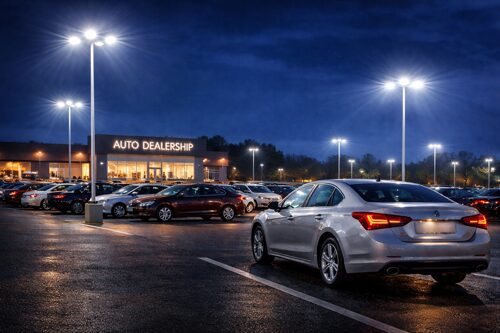
Your dealership’s parking lot isn’t just infrastructure; it’s a sales floor. Every evening, customers walk your inventory under the light you’ve installed. If that light is dim, yellowed, or uneven, you’re not just losing visibility. You’re losing deals.
Lighting shapes how customers feel the moment they pull into your lot. It affects how vehicles look, how safe people feel after dark, and whether browsing customers stay long enough to become buyers. For dealerships still running metal halide or HID systems, switching to LED parking lot lighting is one of the smartest financial moves you can make and one of the fastest to pay back.
This guide breaks down exactly what that upgrade costs, what it saves, and how to evaluate whether it makes sense for your operation.
Why Dealership Lighting Is Different From Other Retail
A grocery store can get away with “good enough” lighting. A dealership can’t.
Auto retail has specific demands that make outdoor lighting more critical — and more costly to get wrong — than almost any other commercial setting:
- Large open lots with dozens or hundreds of vehicles on display at once
- Customers who browse at night, often after work, when light quality matters most
- High-value inventory that needs to be secured across wide open areas
- Brand image that’s shaped by how clean and professional your lot looks after dark
Poor lighting doesn’t just create a safety concern; it actively hurts sales. Paint colors look flat under aging metal halide bulbs. Interiors look dull. Customers feel less comfortable walking the lot at night and tend to move through faster, which means less time engaging with inventory. That shows up in your evening close rates, whether you’re tracking it or not.
There’s also a liability angle. Dimly lit lots increase the risk of slip-and-fall incidents and make it harder to monitor the property. For a facility holding millions in vehicle inventory, that’s a real exposure.
LED vs. Traditional Parking Lot Lighting
Most dealerships run metal halide or high-pressure sodium (HPS) fixtures. These technologies were the commercial standard for decades, but they’ve been overtaken on almost every performance measure. Here’s how they compare to modern LEDs:
| Feature | Metal Halide / HID | LED |
|---|---|---|
| Energy Use | ~400W per fixture | ~150W per fixture |
| Lifespan | 6,000–15,000 hours | 50,000+ hours |
| Warm-Up Time | 5–10 minutes | Instant |
| Brightness Over Time | Degrades significantly | Stays consistent |
| Color Rendering (CRI) | 65–75 | 80–90+ |
| Maintenance Frequency | Every 1–2 years | Every 5–10 years |
One thing the table doesn’t fully capture: metal halide fixtures dim and shift color as they age. Your lot may look noticeably worse two years into a bulb’s life than it did on day one — but because the change is gradual, it’s easy to miss. LEDs maintain consistent output throughout their lifespan, so the light quality you install is the light quality you keep.
Breaking Down the ROI
ROI from an LED upgrade comes from four distinct sources. Understanding each one helps you build an accurate business case before you commit to a project.
1. Energy Savings
LEDs use 40–75% less energy than equivalent HID systems. For a dealership running lights 12 hours a night, that’s a meaningful reduction in your monthly electricity bill, often thousands of dollars per year, depending on your lot size and local utility rates. This is the most immediate and predictable part of the return.
2. Maintenance Savings
Metal halide bulbs need replacing every one to two years. LED fixtures are rated for 50,000+ hours, roughly 11 years at standard dealership usage. When you factor in labor costs, lift equipment rental, and replacement parts, businesses typically cut maintenance costs by up to 90% after switching. For a large lot with many fixtures, that’s a substantial number that compounds over time.
3. Utility Rebates and Incentives
Many energy providers offer cash rebates specifically for commercial LED retrofits. Depending on your utility company and the number of fixtures being replaced, rebates can cover 20–30% of total project costs, sometimes more. These programs exist because utilities benefit when commercial customers reduce their load, and they’re worth pursuing before any installation begins. Sun Bright LED helps dealerships identify eligible programs and handles the application process for every project.
4. Safety, Security, and Brand Value
Better-lit lots reduce slip-and-fall risk, deter theft, and make customers feel more comfortable lingering after dark. Higher color rendering (CRI 80+) means vehicle paint, upholstery, and trim look more accurate and appealing under LED light, which directly influences how customers respond to the inventory in front of them. It’s harder to put a dollar figure on this, but dealerships consistently report improved customer experience after upgrading their lighting.
Example: What a 30-Fixture Dealership Could Save
The following is based on industry-standard data. Actual results will vary based on your utility rates, fixture count, and daily operating hours.
| Example: What a 30-Fixture Dealership Could Save | |
|---|---|
| Current System | 400W metal halide |
| Replacement | 150W LED |
| Daily Operating Hours | 12 hours |
| Electricity Rate | $0.12/kWh |
| Annual Energy Savings | ~$6,300 |
| Maintenance Savings (5-Year) | ~$9,000 |
| Estimated Utility Rebate | $3,000–$6,000 |
| Estimated Payback Period | 12–24 months |
| 5-Year Net Savings | $25,000–$35,000+ |
| Estimates based on industry-standard data. Actual results vary by utility rates, fixture count, and usage hours. | |
A payback period of one to two years is typical for dealership retrofits of this scale. After that point, the savings continue for the remaining life of the fixtures, which with LED is measured in decades rather than years.
Additional Benefits Beyond the Numbers
Dealerships that have made the switch often point to benefits that don’t show up directly on a spreadsheet but matter just as much to daily operation:
- Better color rendering — customers can accurately evaluate paint, upholstery, and trim under LED light, reducing buyer hesitation and post-purchase dissatisfaction
- Reduced light pollution — directional LED optics keep light where it belongs and cut sky glow, which matters in neighborhoods where your lot is visible from residential streets
- Smart lighting controls — many LED systems support dimming, motion sensors, and scheduling, adding another layer of efficiency on top of the base energy savings
- Stronger curb appeal — a bright, evenly lit lot signals to every passing driver that your operation is professional, active, and worth stopping at
These factors are difficult to quantify but consistently show up in feedback from dealerships after an upgrade. A well-lit lot works around the clock, even when your team is not present.
How to Plan a Dealership LED Lighting Upgrade
A successful retrofit involves more than swapping out fixtures. Here’s the step-by-step process Sun Bright LED walks every dealership through:
- Lighting audit — assess your current fixtures, wattage, pole heights, and coverage gaps across the lot.
- Fixture selection — choose LED area lights matched to your specific layout and footcandle requirements.
- Layout design — use photometric planning software to map coverage patterns and eliminate dark zones before any installation.
- Installation planning — coordinate timing and logistics with your electrical contractor or Sun Bright LED’s installation network.
- Rebate application — identify eligible utility programs and submit documentation before installation, where required by the program.
Walking through each of these steps before the project starts is what separates a clean, high-performing upgrade from one that leaves gaps in coverage or misses rebate money. Sun Bright LED manages the full process from audit to rebate submission so ownership and facilities teams can stay focused on running the dealership.m Line
LED parking lot lighting reduces your energy costs, cuts maintenance overhead, and improves your inventory’s visibility at night. The financial case is straightforward: most dealerships recoup the full investment within one to two years and then operate at significantly lower lighting costs for a decade or more.
If you’re still running metal halide or HID fixtures, every month you wait is money left on the table in electricity costs, maintenance calls, and the customer experience your lot is delivering after dark.
Ready to see what your dealership could save? Sun Bright LED offers free lighting audits and custom ROI projections for auto dealerships nationwide. Our team handles fixture selection, layout design, installation coordination, and utility rebate applications from start to finish.
